There is a moment, before the food arrives, that defines every great Persian grill restaurant. It is the smell of charcoal – warm, woody, with the faintest hint of saffron threading through the air. That smell is Joojeh Kabab announcing itself.
Iran’s beloved saffron chicken kebab is one of the purest expressions of Persian grilling. Where Koobideh is bold and deeply savoury – minced lamb pressed onto flat skewers with all the intensity you would expect from Iran’s national kebab – Joojeh is something more delicate. More fragrant. The golden cousin. Same charcoal. Same philosophy. A completely different experience.
What Is Joojeh Kabab?
Joojeh (جوجه) means “small chicken” or “chick” in Farsi, and Kabab (کباب) simply means grilled meat. The name is almost endearingly modest for a dish that has been a cornerstone of Iranian cuisine for centuries.
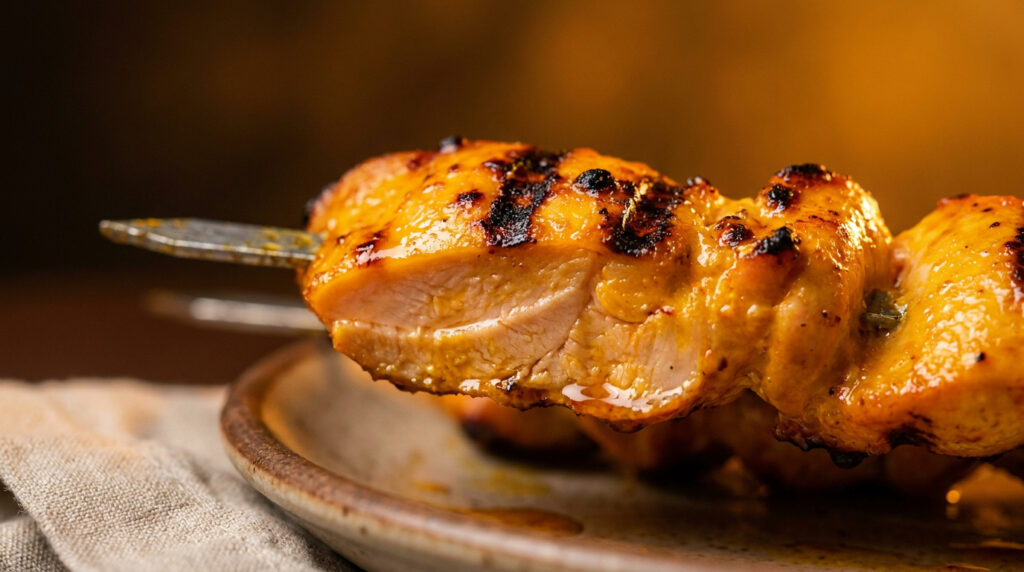
Joojeh Kabab is chicken – traditionally bone-in pieces, though boneless fillets are also used – marinated for hours in a mix of saffron, lemon juice, onion and sometimes yogurt, then grilled over open charcoal until the skin is lightly charred and the meat is deeply golden and fragrant throughout.
It is the dish Iranian families cook at Nowruz picnics. It is what you order when you sit down at a great Persian grill and want to understand what they are capable of. It is one of the most popular dishes in Iranian households – and, when done properly, one of the finest pieces of grilled chicken you will ever eat.
The Marinade: Where Everything Begins
The marinade is everything. Joojeh Kabab without a proper saffron marinade is just grilled chicken. Joojeh Kabab *with* one is something else entirely.
The classic marinade uses four key ingredients:
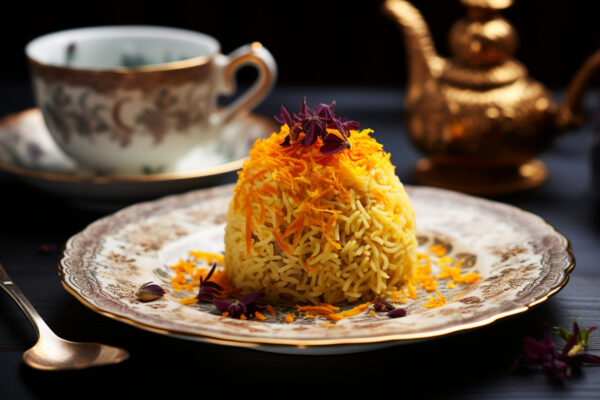
Saffron – bloomed first in warm water to release its full colour and aroma. Persian cooks never add saffron dry. It is always dissolved in a small amount of warm water or rosewater first, then added to the marinade. This step releases the crocin (the pigment) and safranal (the aroma compound) that give Joojeh its unmistakable golden colour and fragrance. We use a generous amount at Shiraz – you can taste the difference between a dish made with real quality saffron and one where the cook has tried to stretch a pinch too far.
Lemon juice – lots of it. This is the acid that tenderises the chicken and also brightens the saffron’s colour. The ratio of lemon to saffron is something Persian cooks develop a feel for over years.
Onion – grated, not sliced. Grated onion breaks down during the marinade to tenderise the meat from within. The juice is what matters; the pulp is sometimes strained out before the chicken is added.
Yogurt (in some versions) – adds richness and helps the marinade adhere to the surface of the meat. Not all traditional recipes include it, but it produces an exceptionally juicy result on the grill.
The chicken marinates for a minimum of four hours – overnight is better. The longer it sits, the deeper the saffron penetrates, and the more pronounced the golden colour becomes after grilling.
The Charcoal Method – Why It Is Non-Negotiable
Joojeh Kabab can technically be cooked in an oven. It is also not really Joojeh Kabab if it is.
The charcoal is not just a cooking method. It is a flavour ingredient. The slight smokiness that clings to properly charcoal-grilled chicken – the faint char on the edges, the caramelisation of the lemon-saffron marinade against intense heat – is what separates this dish from anything achievable in a conventional kitchen.
At Shiraz, we grill over real charcoal. The heat is fierce and direct, and the cook must manage it carefully – rotating the skewers so the marinade caramelises without burning, pulling the chicken at exactly the right moment so it is cooked through without losing its moisture.
Joojeh vs Koobideh: Two Styles, One Philosophy
If you have tried our Koobideh – the minced lamb pressed onto flat skewers – you already know what Persian charcoal grilling is about. Joojeh and Koobideh are the two pillars of the Persian kebab tradition. Different in every detail, united in their relationship with the grill.
Koobideh is intense, deeply savoury, the product of carefully kneaded and seasoned minced lamb that holds its shape through a cooking process that should strip lesser preparations apart. Joojeh is lighter, more fragrant, golden where Koobideh is dark. Together they cover the full spectrum of what a charcoal grill can do with great ingredients and proper technique.
At Shiraz, ordering one of each and sharing is how we recommend experiencing both.
How to Order It at Shiraz
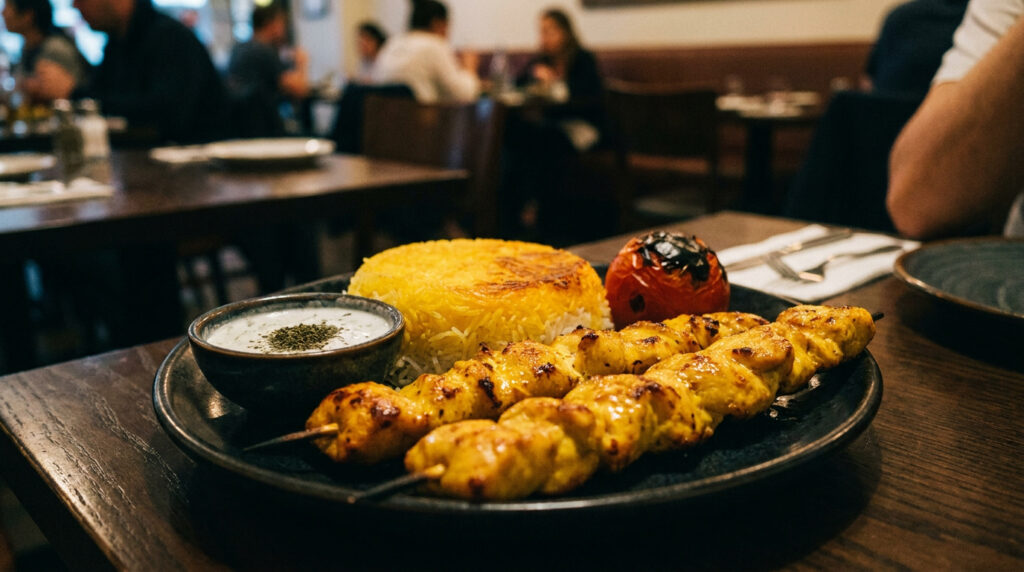
Joojeh Kabab is best with Tahdig – the saffron-scented rice with its golden crispy crust – and a bowl of Mast-o-Khiar alongside to provide a cool, herby counterpoint to the heat of the grill. Grilled tomatoes come alongside, slightly charred, their acidity sharpened by the charcoal.
The full plate – saffron chicken, golden rice, cool yogurt dip, charred tomato – is a complete picture of Persian grilling culture in a single sitting.
We serve Joojeh Kabab because it is what we would order. Come and see for yourself.