Close your eyes and imagine the smell of a summer evening in Tehran — charcoal smoke drifting through the air, the sound of flat skewers being turned over glowing embers, and the irresistible aroma of spiced minced lamb beginning to char at the edges. That is the smell of Koobideh. And once you’ve encountered it, nothing else quite compares.
WHAT IS KOOBIDEH?
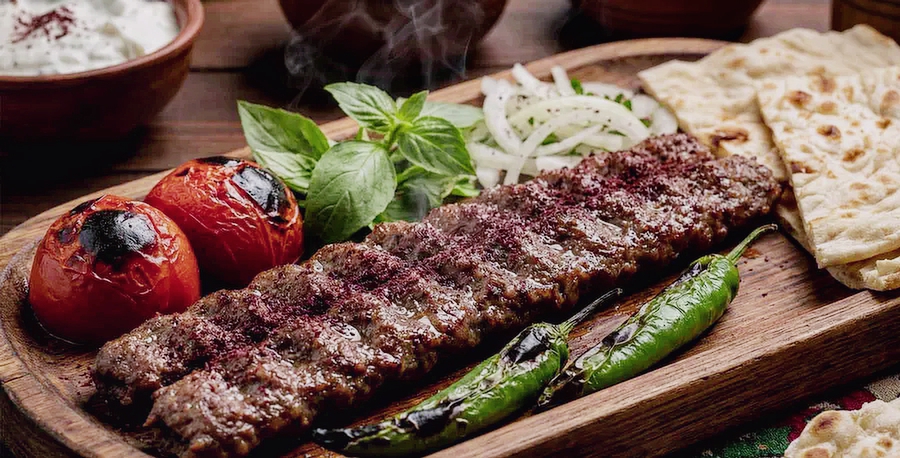
Koobideh (also written Kubideh or Kabab Koobideh) is Iran’s most beloved kebab — and arguably one of the finest grilled dishes in the world. Unlike the chunked or marinated meat kebabs found across the Middle East, Koobideh is made from minced lamb (or a blend of lamb and beef), kneaded with finely grated onion and a careful combination of spices, then pressed firmly onto wide, flat metal skewers and grilled over intense heat. The result is a kebab of extraordinary juiciness — the fat and onion working together to keep the meat moist from the inside while the outside develops a smoky, caramelized crust.
The word “Koobideh” comes from the Persian verb *koobidan*, meaning to beat or pound — a reference to the traditional method of working the meat by hand until it develops the elasticity needed to hold its shape on the skewer.
A STREET FOOD TURNED NATIONAL ICON
Koobideh began as everyday food — sold at street stalls and small grillhouses across Iran for workers and families who needed something satisfying, affordable, and fast. Over time, it transcended class and occasion. Today, it appears at five-star Tehran hotel restaurants and family garden barbecues in equal measure. It is the dish Iranians living abroad crave most deeply. It is the first thing many children ask their parents to cook. It is, in the truest sense, a national institution.
No Persian celebration, no family gathering, no properly conducted Friday lunch happens without at least one round of Koobideh on the grill. Its simplicity is the point: with the best ingredients and the right technique, nothing more is needed.
KEY INGREDIENTS
– Lamb Mince: Ideally with a good fat content (around 20–25%) — this is what keeps the kebab moist and prevents it from drying on the grill. Some cooks use a lamb and beef blend for a slightly firmer texture.
– Onion: Finely grated and squeezed dry. The onion juice tenderizes the meat and adds sweetness; the solids help bind the mixture. The grating and squeezing stage is non-negotiable.
– Salt & Black Pepper: The foundation of the seasoning, used generously.
– Turmeric: A small amount adds warmth and a subtle golden hue.
– Sumac: Often served alongside (rather than in) the meat — its tart, citrusy sharpness is the classic Koobideh accompaniment.
– Bicarbonate of Soda (a pinch): A Persian kitchen trick — it relaxes the protein structure of the meat, helping it stay light and tender on the skewer rather than dense and bouncy.
THE TECHNIQUE BEHIND THE SKEWER
The making of Koobideh is where skill reveals itself. The meat mixture is kneaded firmly — almost massaged — for several minutes until it becomes cohesive and slightly sticky. This develops the proteins in a way that allows the meat to grip the flat skewer without falling off during grilling. The skewers (called *sikh*) are wider and flatter than round ones — typically around 2–3cm wide — so the meat can be pressed around them in an even layer, roughly thumb-thick.
Grilling is done over charcoal, ideally with some distance between the meat and the heat so it cooks through without burning. The skewers are rotated frequently, each turn allowing the exterior to develop colour while the inside stays juicy. A well-made Koobideh should be slightly pink at the centre and deeply browned on the outside — never dry, never grey all the way through.
SERVING SUGGESTIONS
Koobideh is served slid off the skewer directly onto a bed of fragrant saffron rice, alongside grilled whole tomatoes and a knob of butter that melts over the hot meat. Fresh herbs — basil, tarragon, radishes, spring onions — are placed on the side. A generous bowl of sumac sits on the table for sprinkling. Flatbread is always present — to wrap around a piece of kebab, to mop up the juices, to carry everything to your mouth at once. A squeeze of fresh lime over the top is the finishing touch most Persian families swear by.
HEALTH & NUTRITION
Koobideh is a genuinely protein-rich dish. Lamb provides high-quality complete protein alongside zinc, iron, and B vitamins — all nutrients critical for energy, immune function, and muscle health. The onion contributes quercetin and antioxidants. Grilling over an open flame rather than frying keeps the dish leaner than many meat preparations. Served alongside rice and fresh herbs, a Koobideh meal is as balanced as it is satisfying.
KOOBIDEH AT SHIRAZ PERSIAN RESTAURANT
At Shiraz, the grill is at the heart of who we are. Our Koobideh is prepared following authentic techniques — hand-worked meat, flat skewers, and the kind of high-heat grilling that creates that unmistakable crust and smoke. It is one of our signature dishes, and with good reason. Every plate is a reminder of why Persian grill culture is one of the most respected in the world.
Come and taste the king of Persian kebabs. Book a table at Shiraz Persian Restaurant, or order online and bring the flavours of Iran straight to your door.