If you want to understand Persian cuisine — truly understand it, not just taste it — you have to understand the pomegranate.
The pomegranate (anar, انار) has been cultivated in Iran for over 4,000 years. It appears in ancient Persian poetry, in Zoroastrian ritual, in wedding ceremonies, in New Year celebrations, and in every layer of Iranian cooking from everyday home meals to the most elaborate feasts. It is not simply an ingredient. It is a symbol — of abundance, of fertility, of wisdom — that happens to taste extraordinary.
Where saffron gives Persian cooking its colour and fragrance, and zereshk gives it its tart, jewel-like brightness in rice dishes, the pomegranate gives Persian cooking its depth — that bittersweet, complex, layered quality that defines Iran’s great slow-cooked dishes and makes them unlike anything else in the world.
Four Ways Persian Cooks Use Pomegranate
The genius of Persian cooking is that it draws from a single ingredient in multiple forms, each one doing something different in the dish.
Fresh pomegranate seeds (arils) — used as a garnish and textural element. Scattered over rice dishes, stirred into salads, pressed over grilled meats. They provide a burst of juice, a light tartness, and that unmistakable deep-red visual that signals a dish has been finished with care.
Pomegranate juice — pressed fresh or reduced into a cooking liquid. Used in marinades, in braises, and as the acidic base for the balance of sweet and sour that runs through so much of Persian cooking. The juice alone, added to a braising liquid, transforms the flavour profile of a whole dish.
Dried pomegranate seeds — sun-dried to concentrate the flavour, these become intensely sour and are used in some regional Persian dishes as a flavouring agent in the same way sour dried fruits are used throughout Iranian cuisine.
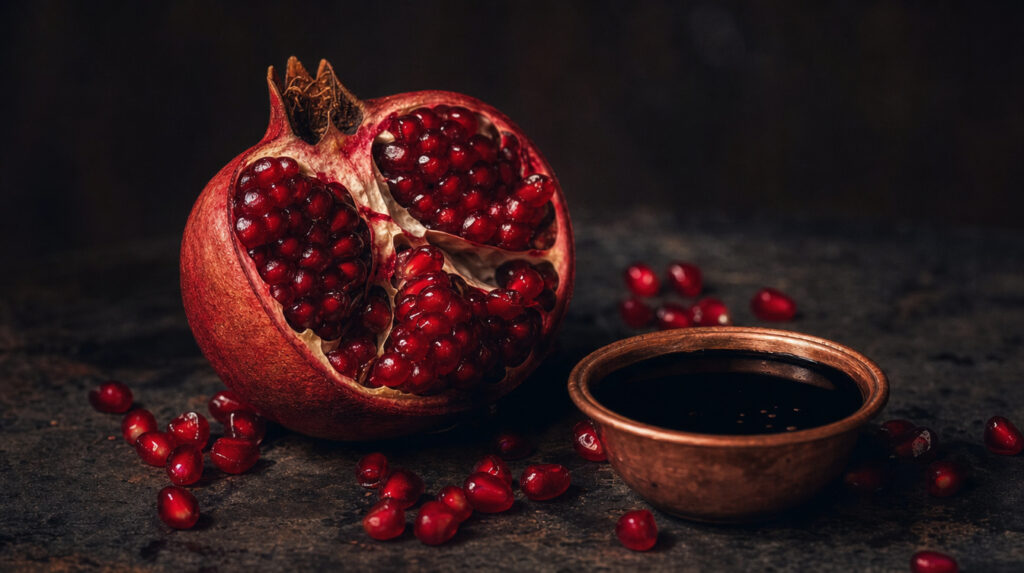
Pomegranate molasses — the most important form for the Persian kitchen. The pressed juice is reduced slowly, sometimes for hours, until it becomes thick, dark, and intensely concentrated. The result is simultaneously sweet, sour, fruity, and complex — with a depth of flavour that has no direct equivalent in Western cooking. This is the ingredient that makes Fesenjan what it is.
What Is Pomegranate Molasses?
Pomegranate molasses is a reduction of pomegranate juice — sometimes with a little sugar and lemon juice added to balance the natural variations in sweetness between batches of fruit, though traditional versions use only the juice itself.
The taste is difficult to describe to anyone who hasn’t encountered it. It has the sweetness of a stone fruit, the tartness of tamarind, the complexity of balsamic vinegar, and an underlying bitterness that gives it an almost wine-like quality. It coats the palate and lingers. It transforms anything it touches.
In Iranian homes, pomegranate molasses is used constantly — stirred into stews, used as a glaze on roasted meats, mixed with walnuts as a filling for certain pastries, added to dressings and marinades. It is the Persian kitchen’s essential souring and deepening agent, doing the work that lemon juice does in some contexts and wine does in others, but with its own irreplaceable character.
Fesenjan: Where Pomegranate Meets Its Match
The most famous Persian dish built on pomegranate molasses is Fesenjan (فسنجان) — and it is among the most extraordinary dishes in any cuisine.
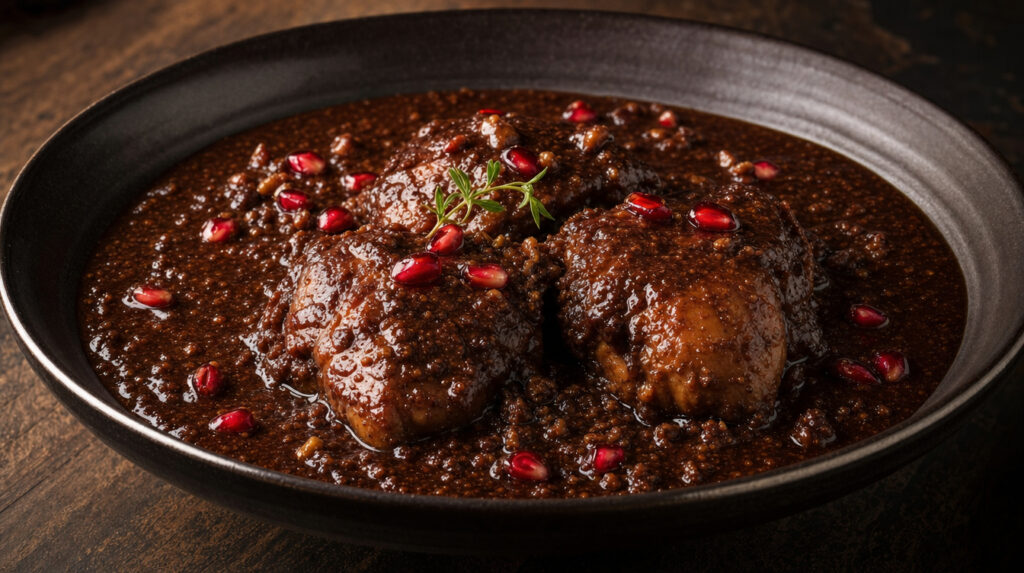
Fesenjan combines pomegranate molasses with finely ground toasted walnuts and slow-cooked chicken or duck in a braise that takes hours and produces a sauce that is dark, glossy, intensely complex, and unlike anything else. The walnuts provide fat, body, and a slight bitterness. The pomegranate molasses provides the sweet-sour depth. The long cooking time marries them into something greater than either alone.
The colour of Fesenjan is almost black — a deep mahogany that looks dramatic in the bowl. The taste is rich without being heavy, complex without being complicated. It is one of the dishes that Persian expats living abroad miss most — because you cannot approximate it. The pomegranate molasses is non-negotiable.
At Shiraz, we make Fesenjan the traditional way. No shortcuts in the cooking time, no substitutions in the ingredients. It is one of our most celebrated dishes for good reason.
The Sweet-Sour Principle in Persian Cooking
Fesenjan exemplifies something that runs through the whole Persian culinary tradition: the sweet-sour balance. Persians have been balancing these two tastes with extraordinary precision for millennia — using pomegranate, zereshk barberries, dried limes, sour cherries, tamarind, and verjuice (unripe grape juice) to achieve a complexity of flavour that Western cooking rarely attempts in savoury dishes.
This is the same principle that makes Zereshk Polo so compelling — the tartness of the barberries against the sweetness of the saffron rice. Two different ingredients, same ancient philosophy.
Pomegranate and Health
Iranian cooks have known for thousands of years what modern nutritional science has recently confirmed: pomegranate is extraordinarily good for you. Rich in antioxidants (higher than red wine or green tea by most measures), anti-inflammatory compounds, and a broad range of vitamins and minerals.
The ancient Persians who built pomegranate into their cuisine were not thinking in terms of antioxidants — they were following taste, tradition, and what they observed about health over generations. But the science catches up with tradition reliably.
Come and Taste It
The best introduction to pomegranate in Persian cooking is a bowl of Fesenjan at a table that knows what it is doing. We recommend ordering it alongside our saffron rice, with Mast-o-Khiar on the side to provide that clean, cooling contrast.
If Fesenjan converts you — and it tends to — the pomegranate molasses that made it is available in Iranian grocery shops across the UK. But there is something to be said for experiencing it first where someone else has spent the hours perfecting the balance.